Pololu 5.3V 6A Step-Down Voltage Regulator (D42V55F5.3)
Price:
Sale price
£38.40
Stock:
Quantity:
Cart
Your cart is empty


The D42V55Fx family of synchronous buck (step-down) voltage regulators generates lower output voltages from input voltages as high as 60V. This version provides 5.3V with a typical maximum current output of 6A, from a 5.3-60V input.
They are switching regulators (also called switched-mode power supplies (SMPS) or DC-to-DC converters), which makes them much more efficient than linear voltage regulators, especially when the difference between the input and output voltage is large.
The regulators have input reverse voltage protection and over-current protection. A thermal shutdown feature also helps prevent damage from overheating and a soft-start feature limits the inrush current and gradually ramps the output voltage on startup.
The efficiency of a voltage regulator, defined as (Power out)/(Power in), is an important measure of its performance, especially when battery life or heat are concerns.


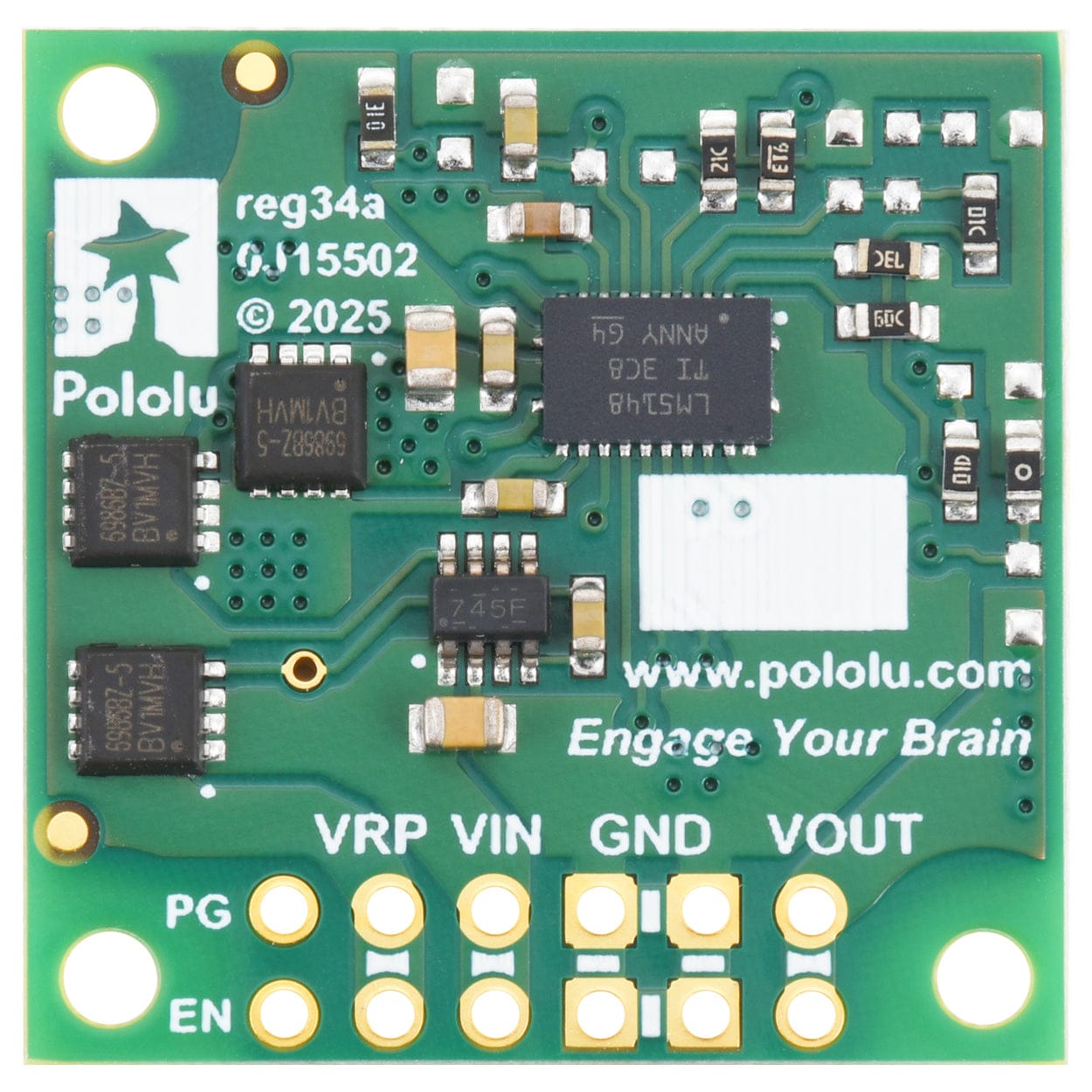
This regulator has six connections, some of which are duplicated on multiple pins:
| Pin | Type | Function |
|---|---|---|
| VOUT | Output | Regulated output voltage. |
| GND | – | Ground. |
| VIN | Input | Input power for the regulator. Voltages between 3.5 V and 60 V can be applied to VIN, but generally the effective lower limit of VIN is VOUT plus the regulator’s dropout voltage, which varies with the load. |
| VRP | Input / Output | Provides access to the input voltage after reverse-voltage protection. This pin can be used as an output to power other devices or as an input point for the supply voltage that bypasses the reverse protection on VIN. |
| PG | Open-drain output | Optional “Power Good” indicator that goes low when the regulator’s output voltage either rises more than 10% above or falls more than 8% below the nominal voltage (typical, with hysteresis). It drives low during soft start and while the regulator is disabled. An external pull-up resistor to the desired logic voltage rail is required to use this pin (100 kΩ recommended). |
| EN | Input | Optional enable input that is pulled up to VIN by default through a 1 MΩ resistor. Reducing the voltage on this pin below 0.5 V disconnects the load and places the regulator into a low-power shutdown mode that draws approximately 50 µA plus 1 µA per volt on VIN. Shutdown mode can be exited by bringing the EN voltage above 1 V. This pin can be left disconnected if this feature is not required. |
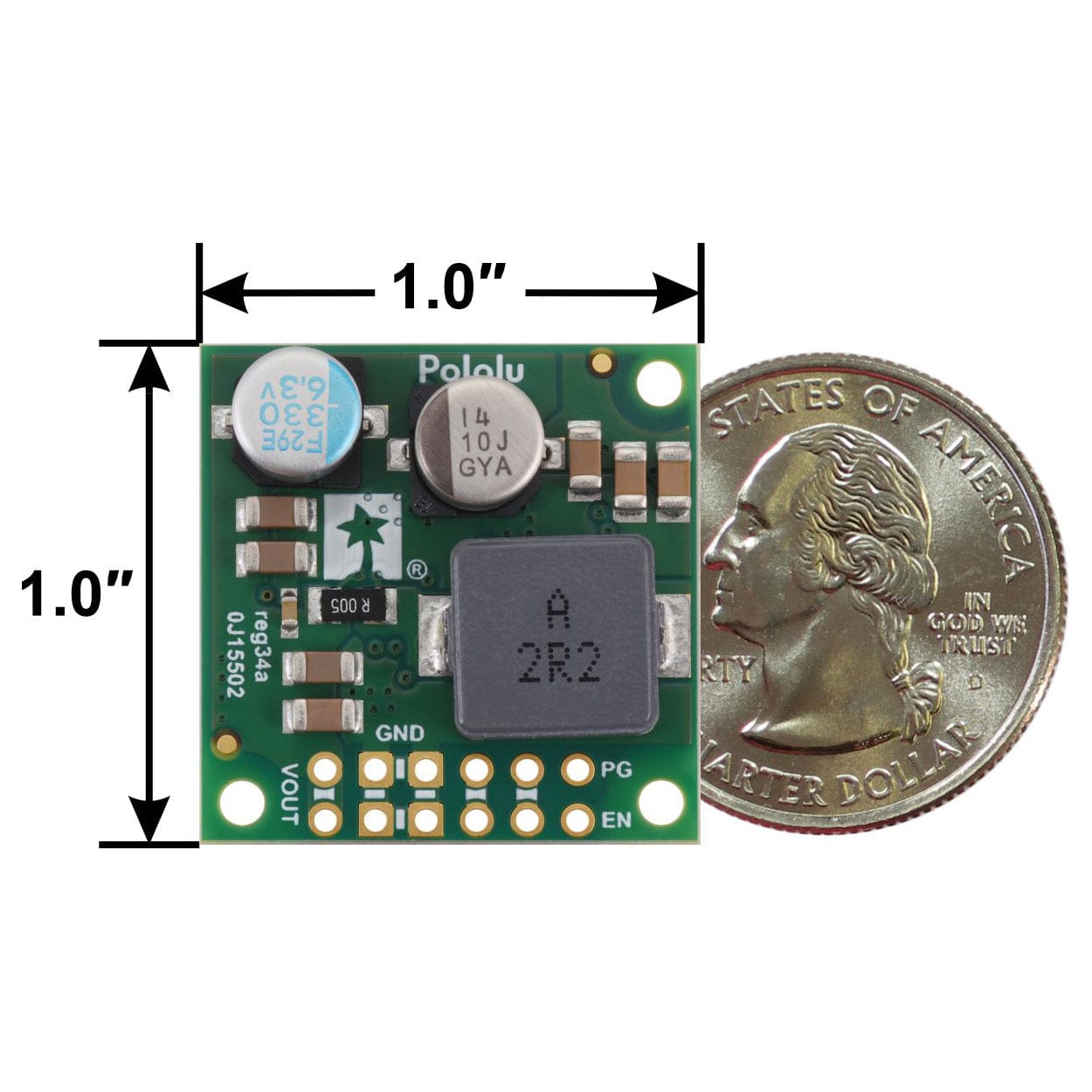
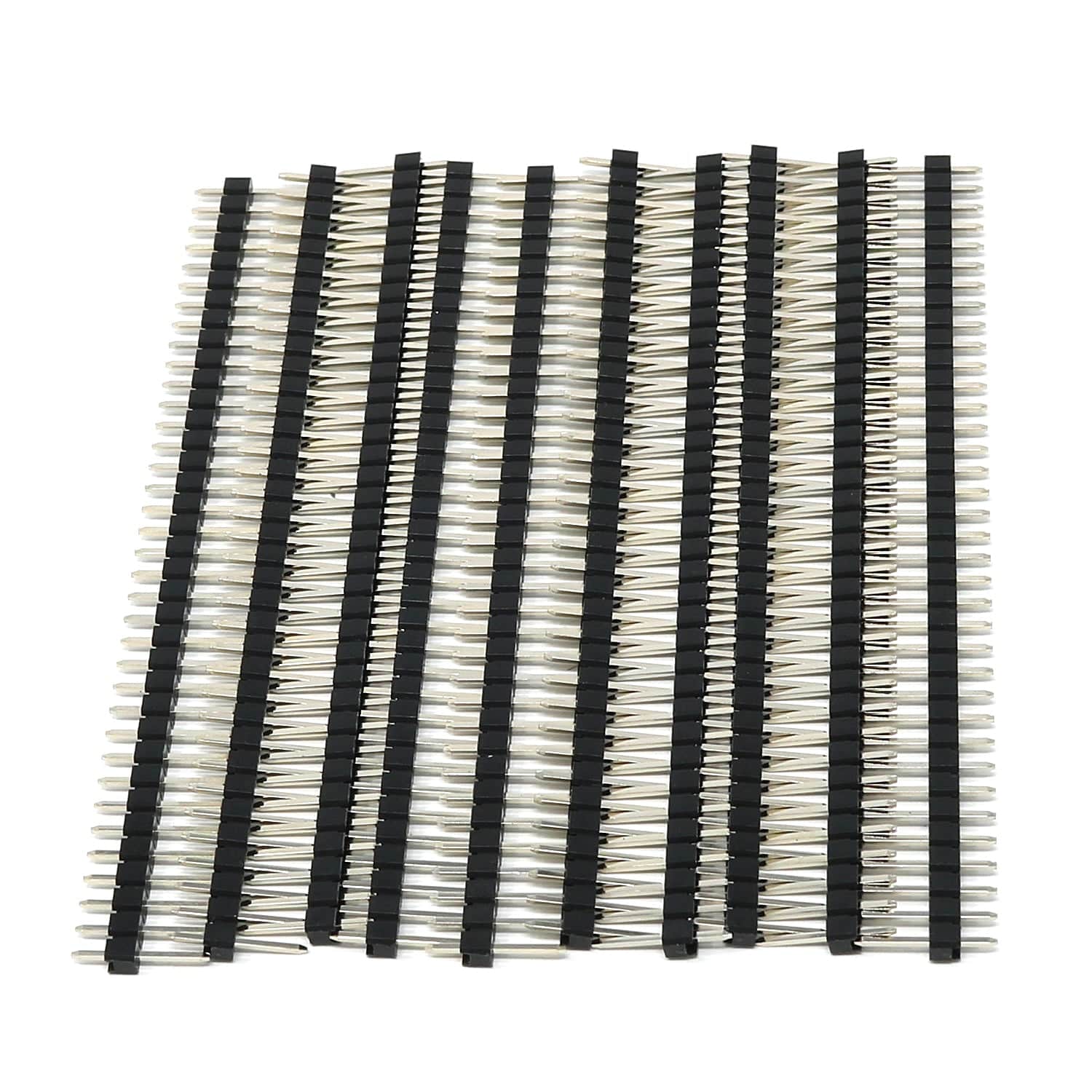
All of the connections are arranged on a 0.1″ grid for compatibility with solderless breadboards, 0.1″ male headers, and 0.1″ female headers. The power connections (VOUT, GND, VIN, and VRP) are duplicated across both rows of through-holes, allowing two header pins to be used for each connection.
Note that the EN and PG pins are not duplicated and are adjacent on different rows, so if you intend to use the regulator on a breadboard, be careful to avoid installing header pins in a way that shorts EN to PG. The PG connection is the only one not accessible along the edge of the board.
The maximum achievable output current of these regulators varies with the input voltage but also depends on other factors, including the ambient temperature, air flow, and heat sinking. The graph below shows maximum output currents that these regulators can deliver continuously at room temperature in still air and without additional heat sinking.

Warning: During normal operation, this product can get hot enough to burn you. Take care when handling this product or other components connected to it.
This regulator has a protection feature that gracefully limits the output current, which can help protect it from thermal damage in applications loads that exceed the regulator’s capabilities. However, this limiting is insufficient to cover all possible combinations of input voltage, output voltage, and load, so we recommend you take precautions to ensure that the continuously applied loads of your application will not exceed the currents shown in the above graph. If your application has the potential to expose the regulator to higher loads, please consider using additional external protective components such as fuses or circuit breakers.
The quiescent current is the current the regulator uses just to power itself, and the graph below shows this for the different regulator versions as a function of the input voltage. The module’s EN input can be driven low to put the board into a low-power state where it draws approximately 50 µA plus 1 µA per volt on VIN (note that for high input voltages, this current draw can exceed the quiescent current draw of the regulator).

The dropout voltage of a step-down regulator is the minimum amount by which the input voltage must exceed the regulator’s target output voltage in order to ensure the target output can be achieved.
For example, if a 5 V regulator has a 1 V dropout voltage, the input must be at least 6 V to ensure the output is the full 5 V. Generally speaking, the dropout voltage increases as the output current increases. The two graphs below shows the dropout voltages for this family (the 3.3 V version has its own separate graph because its dropout voltage curve is very different from the other members of this family):

| Minimum operating voltage | 5.3 V1 |
| Maximum operating voltage | 60 V |
| Output voltage | 5.3 V |
| Output type | Fixed 5.3 V |
| Continuous output current | 6 A2 |
| Maximum quiescent current | 10 mA3 |
| Reverse voltage protection | Yes |
| PCB dev codes | reg34a |
| Other PCB markings | 0J5502, blank white box |
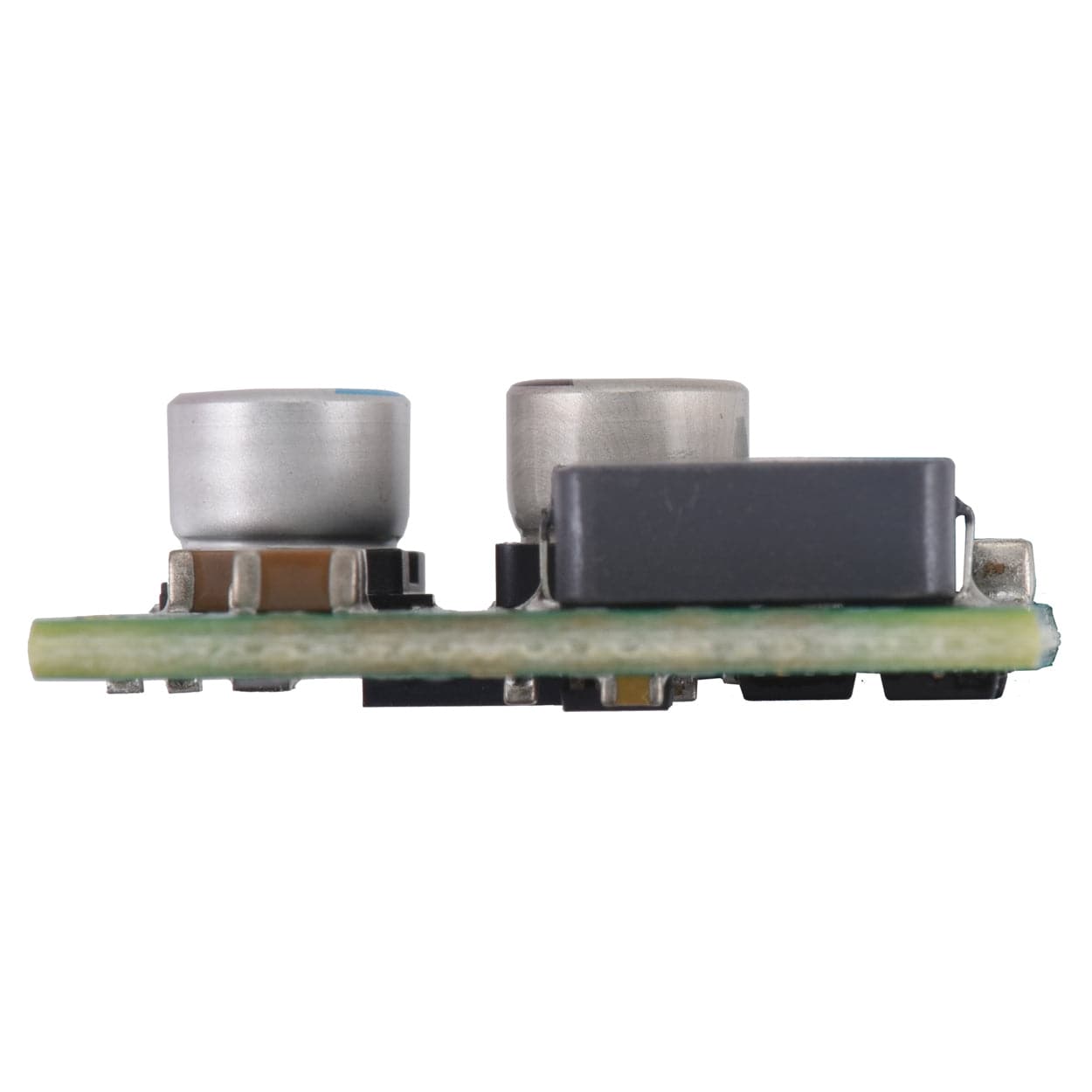
| Size | 1.0" × 1.0" × 0.355" |
| Weight | 6.5 g |
Your payment information is processed securely. We do not store credit card details nor have access to your credit card information.